8 insights into wellbeing at work from our market research - part 1

What is the real state of wellbeing in the workplace today? To find out we conducted a market research in collaboration with iVOX among more than 1,000 employees and 300 HR professionals in Belgium, asking them about their needs, expectations and barriers regarding wellbeing. In this article, we focus on results concerning the policy side: where organisations stand today, where the biggest areas of tension lie, and what role perception and leadership play in this.
1. Investing in wellbeing is becoming more self-evident
First, the good news: the importance of investing in wellbeing at work is becoming less and less of a point of dispute. Almost 7 in 10 employees recognise the added value of a wellbeing policy within their organisation. Among HR professionals, that figure is even higher, with 9 in 10.
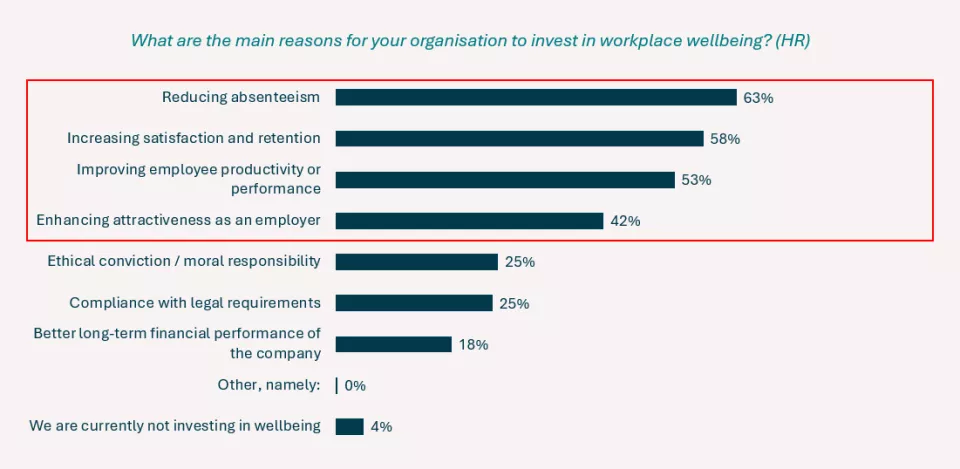
Organisations today invest in wellbeing based on various strategic objectives:
- reducing absenteeism
- increasing satisfaction and retention
- improving performance
- becoming a more attractive employer
Wellbeing is increasingly seen as an investment that contributes to sustainable business results rather than a cost. It is noteworthy that in our research, improved long-term financial performance is rarely, if ever, cited as a driver for investing in wellbeing. However, research by Jan-Emmanuel De Neve (University of Oxford) has shown that there is a clear positive relationship between employee wellbeing and an organisation’s financial performance.
2. Many initiatives, limited strategic embedding
Nine out of ten organisations are currently rolling out wellbeing initiatives. That sounds promising, but there are a few nuances:
- Only one in seven organisations has truly embedded wellbeing in its business strategy
- In many cases, these are isolated initiatives
- The impact and objectives are still not being followed up on or monitored sufficiently
In other words: organisations are taking steps, but often get bogged down in fragmented actions. The challenge lies not in getting started, but in sustaining and structuring these efforts.
3. The gap between HR and employees remains big
One of the most striking insights from the research is the perception gap between HR professionals and employees. While 78% of HR respondents believe their organisation is successfully rolling out wellbeing initiatives, only 51% of employees agree. Furthermore, 6 in 10 employees also say that the initiatives launched do not meet their needs.
We also observe differences at a strategic level. What appears to be a clear approach to HR is perceived differently, or not at all, by employees. Yet perception plays a crucial role. A policy that is not ‘felt’ has little impact. Clear, consistent and transparent communication is therefore essential.

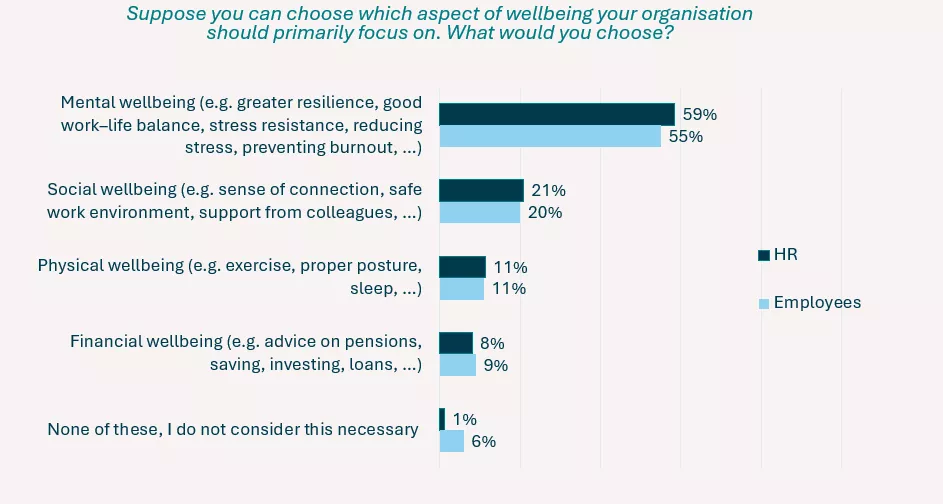
4. Mental wellbeing remains a top priority, but social wellbeing is also crucial
When organisations have to choose where to focus their efforts, mental wellbeing clearly emerges as a priority. This is not surprising in a context where 25% of employees show an increased risk of burnout.
It is striking that social wellbeing comes in second place and is considered twice as important as physical wellbeing. Yet the impact of this pillar is still often underestimated, while research shows that a strong sense of connection or ‘belonging’ is just as decisive for employees’ wellbeing as their pay (De Neve & Ward – Why workplace wellbeing matters). Consider, for example, the importance of a close-knit team, open communication, recognition and inclusion in the workplace.
What can your organisation do today?
The insights above highlight several challenges and consequently, a number of opportunities. To make the most of these opportunities, we have two concrete recommendations.
1. Start by measuring
According to our research, employees recognise that efforts are being made regarding wellbeing, but they do not always perceive these as relevant or tailored to their needs. That is why it is crucial to start by measuring, for example through a wellbeing survey. This is the only way to gain insight into what your employees really need. There is no one-size-fits-all approach.
And, not unimportantly: even when wellbeing initiatives are well-aligned with needs, the way in which you make them visible and frame them for employees remains decisive. Our white paper from 2024 shows that the perception of a ‘caring employer’ is strongly linked to higher psychological wellbeing. In other words: it is not just what you do that counts, but also how you communicate it and make it tangible for employees.
2. Dare to look beneath the surface
Don’t just tackle the symptoms, but also the underlying causes. Look at the broader work context: autonomy, flexibility, the relationship with the manager and the exemplary behaviour of senior management play a crucial role. Do you notice problems in one or more of these areas? Don’t let this slide, but look for a solution that is workable and sustainable for all parties involved. This more in-depth approach requires more time and commitment, but delivers the greatest impact in the long term.
Fancy some more insights and advice? In part 2 of this article, we delve further into our market research.